Why I call my work Art Glass: As I was teaching students beginner stained glass during my apprenticeship, I’d explain that the class name is a bit of a misnomer. That we would not be painting or staining anything, just utilizing the details within the glass to enhance our designs. This once prompted a student to raise her hand and ask me, what would you call it? I was floored, I did not know how to identify what I was teaching without using the phrase stained glass. Enter my grad. Research Methods class and voila! I was given an opportunity to dive in and investigate my conundrum. After my research, I chose to call my work Art Glass, because I currently do not stain or paint any of my glass. I artistically curate the pattern pieces to highlight the glass color and textures in my work to imply depth, shape, and movement.
Is your work stained glass? Technically yes, because the term stained glass is generally applied to any glasswork with pieces of cut glass that are held together with a rigid structure. I will occasionally use stained glass as I talk about my work, old habits die hard. However, my work better identifies as art glass, that is until my wheel house expands and I’m staining and painting glasswork, only then will I feel fully comfortable truly calling my work stained glass.
Isn’t art glass a general term that applies to multiple art forms? Yes, it does apply to more art forms than what I do as well. Art glass can be used to reference blown glass shaped into functional and sculptural forms, and mosaics also fall into art glass realm. It is a challenge to identify your work with a common description that everyone will recognize off hand. It is one reason why the term stained glass is widely used. It is ingrained in our vocabulary, and is recognized immediately by the general population [Cathedral windows or transom windows in homes]. However, what they may be picturing is not exactly what I am creating or the method that I used to create my artwork.
What is your process? I am fluent in the copper foil method, also coined as Tiffany-style. What it means is that I score and break glass out of large sheets of glass, grind the edges to knock off the sharp bits. The act of grinding the glass roughs up the edges surface for adhesive backed copper foil to adhere when burnished. My foiled pieces fit together like a puzzle (not too snug, and not too loose), and I use an acid catalyst (Flux) to coax my solder (60/40 tin/lead metal alloy) to flow (melt) onto the copper foil. The combination of flux and heat causes the solder melt and bond to the copper, essentially locking everything together. I add a zinc frame around most of my pieces, and depending on the size of the piece I may solder in a support wire or bar. This will minimize bowing over time and generations will enjoy the art work!
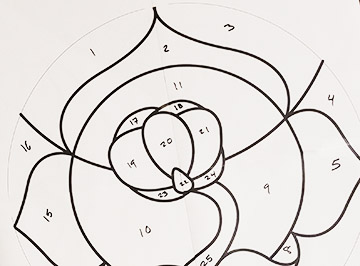
Cartoon
The final drawing is called a cartoon or pattern, due to it being a line drawing.
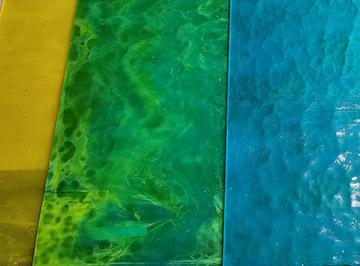
Glass Selction
Once the pattern is ready to be cut up into pieces, the glass is selected for the project!
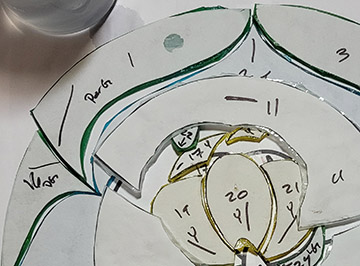
Glass is Cut
The pattern pieces are glued to the glass sheets and broken out with a glass score.
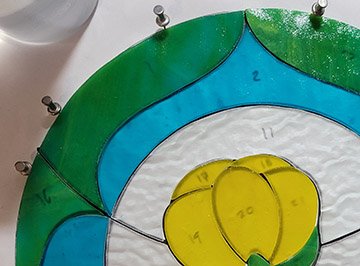
Grinding
The glass pieces are ground down so they fit properly and the foil has a good clean surface for the best adhesion.
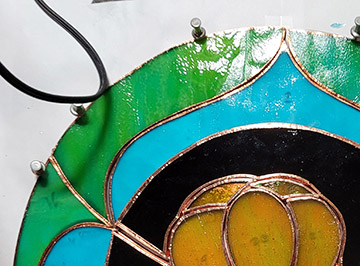
Foiling
The glass is foiled as evenly as possible. Sometimes wavey or textured glass will have wider and thinner spots in the foil.
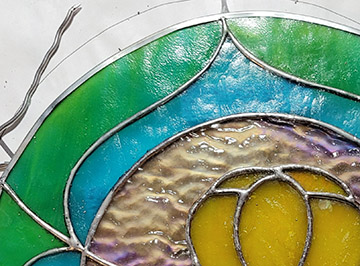
Solder
Soldering isn’t the final step in the, but it is a very satisfying moment! After soldering you patina and polish the piece.
 Katt Marshall Creative Studios